A blog for and by a group of certifiable and committed cyclists (aka, Cyclopaths) from the Puyallup, Tacoma, and Seattle area. Follow The Puyallup Cyclopaths' adventures as they ride in the mountains of the Northwest and beyond.
The
Cyclocross Revolution's most North venue was at the Arlington Airport.
The airport is active but has various corners of the property that have
been used for cyclocross events in the past. My wife Deanne decided to
join me for this race as did our Lab mix Poppy.
Lots of yellow tape used to layout the
labyrinth of corners
This year the Cyclocross Revolution course designers were thrown a
curve ball for the Arlington event. Just a week before the event they
were asked to use a different part of the airport property than
originally planned. They were given a basically flat grass field that
just wasn't all that large. The course was mostly yellow tape
partitioned corners on the grass.
Just before heading out to preview the course I ran into Rob. He gave
me an idea what the course had in store. He warned me about the
imported sand section and also mentioned some short technical sections.
One of them, he said, was a slow but rideable corner through a ditch.
During my course preview I learned that many of the grassy courners
could be ridden without much need for braking nor accelerating if I
chose my line carefully. The imported sand was placed with enough lead
in straight that I could usually accelerate to speed, lift out of the
saddle to help the tires float, and then coast through. Then I got a
much better look at the real technical test on this course.
A short stretch of pavement progressed from flat to downhill. Near
the bottom the pavement changed from dry to wet to dirty before entering
the woods and a left turn with two separate lines. The inside line was
short while the outside line allowed a better approach to the runup.
After my preview I explained to Deanne that this might be the only real
technical part of the course. The changing traction conditions required
caution but I felt pretty good that I could charge flat track style into
that corner and use the inside line to make passes. Whoa! Now that's a trainer.
After course preview I mounted Blue Moon onto my trainer and
continued my warmup. Following Rob's guidelines from our previous chat I
planned to spin for 25 minutes. Those 25 minutes also included a couple
short efforts to get the heart rate up a little extra bit. I liked this
addition to my race day ritual as it gave me a little time to be inside
my own head.
My trainer is a Plain Jane magnetic trainer that always works but
sometimes makes an awful jet engine racket. The racer parked next to me
unloaded the coolest looking trainer I'd ever seen. He removed his rear
wheel and mounted the bike directly to the trainer which had it's own
cassette. Is 'trainer envy' a word?
As I prepared to get my warmup going Deanne and I chatted about what I
found on the course and I told her about the downhill being my only
strong point of the course. After preview I also reflected that Fort
Steilacoom may have been fast but that the power sucking soft grass and
ground would make this a tough course for me. We also chatted about
where best to watch from. It turns out she found a spot in the infield
where the course came close four times.
The start included the entire front straight which was probably the
bumpiest and softest portion of the course. I really hated this portion
of the course. Good news came in the form of a call up based on my
finish at Silver Lake. The starting line
Cyclocross is described as having a sprint that comes as the
beginning of the race instead of the end. In an effort to keep myself
together I pedalled hard off the line but just enough to keep me in the
top 10 going into the first set of corners. I quickly learned that I
could stay with the rider in front of me through the twisty tapes as
long as I had the room to freely choose my line going in and out of the
corners.
The first two laps went pretty smoothly and I stayed near the front.
During the second lap I realized I needed to ride my own pace and I let
the riders in front of me go.
On lap three my left foot did not release from the pedal going into
the double barriers. Fortunately I fell sideways through the tape and
not forward into the wooden barrier. By the time I was done uncleating,
becoming vertical, and reestablishing forward motion I had lost two or
three positions. The rest of the lap was filled with self talk. I was
tired. But I knew I could do better. I chanted 'relax, relax, rotate
foot' as I attempted regained my composure. This lap was about 15
seconds slower than my average.
I know how to wheel a bike around corners. I can pedal it well
enough. But lap three really demonstrated something I've known for a
while. My Cyclocross specific skills like dismounting, remounting, and
run-ups are still at a category four level while I'm racing against
category three riders.
From her prime viewing spot I got to see Deanne every lap. She
cheered me on but I did not hear the exact words over the sound of my
own breathing. I was hurting yet I always nodded or waived or at least
lifted some fingers to let her know I appreciated her attendance. Our
dog solemnly stared in the opposite direction.
This race was my first on tubulars. I've been testing, flatting, and
sealing this wheelset since September. With zero race condition data I
chose to go with 26 psi front and 29 psi rear. This seemed to give good
front to rear balance. During my sighting lap I found that the front
tire gave great feedback. From my roadracing days I learned to
appreciate tires that were predictable and let the rider know that side
bite traction was near it's limit instead of going from full grip to
full slip. The rear at 29 psi gave a smoother ride than the clinchers I
normally ride. It wasn't until the race, however, that I felt just how
much that rear tire was deforming. One set of sweeping turns was set up
on harder terrain that allowed a little more speed. Cornering over the
bumps while pedalling worked that rear tire hard. If felt like it might
roll right off the rim yet it just kept gripping. It felt odd. But it
sure worked. Short sweeping turns
Laps four and five were not special. I worked to keep my pace even.
Occasionally I would catch and pass a rider that was falling back from
the start before mine. And I was hurting. But not too much.
My lap times were pretty consistent with two exceptions. I worked
harder on the first lap and it fell about 15 seconds faster than my
average. I fell on the third lap and that lap was about 15 seconds
slower than my average. The other four laps were within ten seconds of
each other. I'm definately getting better at listening to my body during
the race.
Our class got six laps at Arlington. For me that meant almost
48 minutes of fun. It also meant I was looking forward to that last lap.
My breathing was under control as I started the final lap and I needed
to continue to keep my pace correct. The first third of the lap was
spent gliding through the taped grass corners and slowly closing the gap
on two riders in my class. As we approached the ditch I didn't feel I
could complete a pass. So I took it easy going into the ditch and closed
the gap coming out.
The next thirty seconds were soft grass and the two riders ahead were
a tiny bit faster. With just half a lap to go I started weighing my
options. These two were definately fitter. The finish straight would
play to them not me. Then we passed Deanne. Again our dog stared off
into space. And Deanne cheered. And most of her words were lost. But the
word 'hill' was not. The time and place to 'go' had arrived and Deanne
reminded me of it.
There were just two corners between my cheering section and the paved
downhill. Out of the saddle I closed the gap
and then powered down the hill. It wasn't pretty. I headed to the short
inside line, right leg arrow straight, bike definately crabbing
sideways, feathering the rear brake and kicking rocks onto my own bike
as my left foot skimmed the surface. When the two lines converged at the
bottom of the run-up I had them both in my back pocket. Then my cat 4
skillset showed itself again as I couldn't avoid a fallen rider's bike
while dismounting. A quick stop, apology, and lift got my bike over. By
the top of the run-up it looked like my plus two was lost but one
rider's remount went awry and cost him a second. I was on the other
rider's back tire.
My charge was not over. I watched the gap behind on the following flat paved
section and it stayed at one second. The paved section ended with two
long tecnical 180's that were good for me. I punched past the rider in
front of me going into the first of these two corners and gained another
second coming out of the second. Another good turn of fortune was that
between the two technical corners I caught and passed a rider not in my
class. This put a rider between me and my two rivals coming back into a
grass section. I kept the pace up. It felt good to get out of the saddle
and accelerate out of the grass turns. Then I caught and passed a
second rider not in my class just before entering the corkscrew.
The corkscrew, on retrospect, was one funky corner. It started as a
gradual right hander that turned the rider through 450 degrees. Thats
not a typo. Riders entered going North. Turned right until they were
going North again. Then turned an additional 90 degrees until they
headed East. The course literally wrapped around part of itself. Then
the riders turned left through 270 degrees until they were headed South.
Most of this corner was gradual. The exception was the last 90 degrees
of right and the first 90 degrees of left. These parts were tight and
slow. Most of the corkscrew was taken single file. Which was fine on the
last lap since I was leading my group.
I felt good going into the corkscrew. I had just passed two riders in
my class. I knew that passing the two riders not in my class could work
to my advantage. I was leading this quartet into the final minute of
the race. And there were a couple corners after the corkscrew I liked
before our group would settle it on the long grass finish straight.
I was ready to work for a gap before getting onto the straight. Once
through the tight section of the corkscrew I got out of the saddle and
BLAM. I was on the deck. I heard a metallic sound. More than a squink.
Just as I found terra firma. I had hit a rock I didn't see and it rolled
under my front tire enough to dump me. I heard a rider shout 'get up'. I
jumped back up and remounted with haste. But not before four bikes rode
past. I put in some effort and caught the last of the quartet at the
final corner. But I could not equal his finish line speed and trailed
him over the line.
My aggressive cornering sometimes gains me positions or allows me to
save energy. But at Arlington I crashed out of 8th to finish 10th in my
class.
I coasted to a stop, got off the course, and layed down on the ground. All that work. Wasted. On a rogue rock. This sand imported (from Belgium??) fresh
for this event
One observation I've made over the last year of CX racing is about
the designs on racer's jerseys. I think most riders are matching kits
that say something like "A graphic designer created me, I'm based on my
sponsor's nifty color palet, I'm sophisticated yet subdued." My Puyallup
Cyclopaths Jersey seems to scream "Look at me, I climb mountains, lots of
'em, Look at me!". Regardless of the the jersey's dialogue, my Puyallup
Cyclopaths jersey makes me easy to pick out of the crowd. Both during
the race and after.
The first racer to approach me after the race was Forest Murphy. He
said he stayed just 5 or 10 seconds in front of the group I finished in
most of the race and could often pick me out of the group due to my
jersey. He also said he was the third racer in my group at the Fort
Steilacoom race. He said "I don't know what happened. I was on your
wheel. Then there was a gap. I nearly closed the gap but then I was out
of gas". I admitted to him that I jumped pretty hard at Steilacoom to
create that very gap. We also talked about crashing. Forest does some
road racing and expressed that stepping off at ten miles an hour onto
grass is a lot less intimidating than stepping off at 45 miles per hour
onto pavement. I had to agree with that.
Then Mario found us. I introduced him to my wife as 'the guy that
broke his wheel' and we chatted about the bad luck he had at this years
Cyclopaths rides. (Frozen riders on Skate Creek and broken wheel on
Triple By-Pass). We also compared Cyclocross schedules and realized we
won't be at many of the same races due to his Northerly location and my
Southerly location. But it was nice to see Mario again and I told him we
would ride together again next Spring with better wheels and better
weather.
On the drive home I thought about my day's performance. My two
weaknesses were fitness and lack of speed through the barriers. I'm
continuing to train and beleive that I'm slowly getting stronger. But I
haven't practiced dismount/run/mount since last summer so that will need
to get into my schedule.
Sprinker is the next event on my CX calendar. Last year the course
suited me and maybe I'll have another good showing this year. Either
way, I'll tell you all about it right here.
The 50 mile segment from the top of Salt River Pass to
Alpine is mostly downhill.After the
initial descent from Salt River Pass, which is steep and fast, the grade levels
out to a 1 to 2% downhill grade. It feels similar to riding from South Prairie
to Orting on the Orting Trail.
Because of my hesitation at the top of Salt River Pass and
my initial decision to coast, I didn’t maximize my speed on this downhill.Last year I reach over 51 MPH.This year my top speed was only 48 MPH.I easily caught the rider in the red jersey
(he was coasting).I waited until the
main part of the downhill leveled out and then I sat up and drank some of my water
and ate some food.
LOTOJA has an early registration on the Thursday before
LOTOJA at a bike store in Kaysville, Utah.You can also register on Friday in Logan, Utah.Rex and I like to pick our packets up on
Thursday at the bike store.This gives
us plenty of time on Friday to put our race number on our bikes and
jersey.We also like looking at the bike
store.The bike store always has deals
and specials going on.Undoubtedly, the
day of LOTOJA packet pickup has to be one of their better sales day of the year.
While in the store, a vender introduced me to a relatively
new product by GU.It is an electrolyte
capsule called Roctane.What caught my
attention is that the capsule contains some ginger.I was just reading a few days before I was at
the bike store that ginger can help settle an upset stomach.I was intrigued because I did get an upset
stomach the first year I road LOTOJA.It
was no fun so I thought having some ginger was a good idea.
I purchased a few of these capsules.I usually get my electrolytes from my scratch
drink mix.However, I knew that I was
going to take some water hand ups, which would not have any electrolytes.As a result, I thought that having some
capsule electrolytes were a good thing so that I could take them with my water
and hopefully stave off going negative in that department.I knew this was a risk.One of the number one rules for endurance
riding is not to eat or drink anything you have not practiced eating and
drinking before race day.I thought that
this was basically a salt tablet with a few other ingredients.So, I didn’t think it could hurt me very much.
I have found that it is easier for me to take capsules on
the bike if I use a pill bottle.I
create my own pill bottle by using a plastic tube that comes with gum or candy,
like m&ms.I was carrying two
plastic tubes, one for the electrolytes and one for ibuprofen.
As I sat up to eat and drink, I took a couple of the Roctane
electrolyte capsules.As I did so, I
glanced back behind me to see the rider in red working hard to catch me.I sat up and waited for him.We exchange brief pleasantries then got down
to business.
The red jersey rider was from the Masters 45+ group.He had lost contact with the leaders of his
group before the king of the mountain climb.He was a nice guy, and we started working well together.We would trade pulls, and I felt myself
getting stronger with each pull.I was
able to maintain 30 MPH through this section with the help of a slight downhill.I was feeling really good.I was working hard, but not too hard.It was a comfortable hard pace.
The two of us worked well together and were able to maintain
our pace.I noticed the rider in the red
jersey was riding in his large chain ring and had his chain on the smallest cog
in the back.He was using a low cadence
to keep the pace.I on the other hand
was spinning a higher cadence.I think
the rider in the red jersey was happy to draft behind me.Most people enjoy it because I create a large
draft.
I am not sure what it was, but my legs were feeling really
good.It might have been that I was
under fueled and fueling up right before the climb was kicking in.Perhaps it was the Roctane caplets.Or maybe, my body was just happy to not be
peddling uphill anymore.I kept feeling
stronger and stronger.
It is 17 miles from the top of Salt River Pass to the next
feed zone, which is Afton, Wyoming.My
brother lives in Afton and it was his family that was supporting Rex and
I.In addition, my mother and sister
happened to be visiting my brother so they also agreed to help us.They all took their Saturday to support Rex
and I.I was excited to get to Afton to have a mini
family reunion (well a 30 second one anyway).
I also was excited to get a peanut butter and jelly
sandwich.Last year, my sister-in-law
had these great peanut butter and jelly sandwiches waiting for Rex and I at the
Afton stop.In my food instructions
taped to the top of our food container that my nephews picked up in Montpelier
were instructions to have another peanut butter and jelly sandwich ready.It tasted so good last year after 120
miles.I was anxiously looking forward
to that sandwich.
I kept expecting our pace to slow down a bit, but it
didn’t.We were flying and it was a lot
of fun.The miles just were melting by
us as we rode along.I am not very smart
at times, so it took me a little while to figure what was happening.I kept thinking that it was too easy.Star Valley is known for usually having a
cross wind or a head wind.The success
to riding in Star Valley is finding a group that will keep a strong pace.It is usually too taxing to ride it on your
own because of the wind.As I thought
about this, it finally dawned on me.We
had a tailwind!I don’t think it was a
huge tailwind, but any tailwind is better than a headwind in Star Valley.Having a tailwind through Star Valley is a
rare occurrence.
At that moment, I had a clarity about LOTOJA that I had
never thought about before.It is not
about whether you are going to have a headwind or a tailwind.It is about where is the headwind going to be
and where is the tailwind going to be.The
course is so long that there are headwinds and tailwinds all over depending
upon where you are and what time of day you are riding.The slow Preston ride made more sense to me
at that moment because we surely had a headwind.Later that night my brother-in-law who also
lives in the area confirmed that the wind was blowing from a direction it does
not normally blow.
The knowledge of a tailwind may a huge difference to
me.As I mentioned in the last post, you
have to average about 25 miles per hour through the valley to have a decent
time.I knew with a tailwind, I could
likely maintain 25 miles per hour on my own.I did not have to depend on anyone else.This meant I could ride my race and not worry about getting caught alone
without a group.
As the red jersey rider and I continued to motor along, I
kept getting more and more excited about the peanut butter and jelly sandwich
that was getting closer with each passing mile.This is a good time to talk about nutrition and LOTOJA.
I have mentioned before how important nutrition is.If you don’t keep your body fueled property,
you will likely run out of gas later in the race.As you know, your body can only absorb so
many calories and carbohydrates in an hour.The harder you work the less absorbs ion your body can handle.
I try and calculate about how many calories my body can
handle in an hour.Because I lose my mind
and am not very good at tracking this on the bike, I try to take the work out
of it.I calculate how many bottles of
drink mix I will drink an hour.Because
of the mild temperatures, I calculated I would need about a bottle and a half
an hour.I then figure out how many
calories that will be.I then calculate
how much of the remaining calories I need to eat in food.I put food with those calories in a little
sandwich bag.This way all I have to
remember is to drink a bottle and a half and eat the contents of the sandwich
bag each hour.
I had calculated about the time I thought it would take me
to reach Afton, and had 5 sandwich bags of food, one for each hour.I also added two more bags.One was just an extra in case I dropped a
bag, and the other was a second back-up in case I had miscalculated and my body
was telling me I needed more food.
As you reach Afton, the road gets really fast.The past year or so they have been repaving
the road.The asphalt becomes
smooth.It is always a fun 10 mile
section or so riding on this new pavement.
We came into to Afton still keeping a blazing pace.When we hit the newly paved asphalt, my
expectations were not disappointed.It
was really fast.I also was excited
because I knew the feed zone was just up a head and so was my peanut butter and
jelly sandwich.
As I explained before, when you pull into the feed zone,
there are numbered sections on the side of the road just like pit stops.Each rider tells his or her support team what
number to wait at for him or her.This
helps them find each other easier.Afton
is the first time when the racers and cyclosportive groups share a feed
zone.Most riders have a few family
members helping them, so there are a lot of people at these feed zones.It is often difficult to find your support.
In riding LOTOJA fast, your support team is very
important.They need to be ready to give
you your liquids and food so you can be on your way.As I explained before, many of the racers
don’t even stop.They grab musette bags and
keep riding.If your support does not go
well, it could ruin your whole day.
Just think for a minute.Most people have family members who have committed to help them.They give up the whole Saturday for
this.They sit around at the feed station
waiting for their rider to come.They
don’t know exactly when he or she will get there.Finally they arrive and are there for less
than 30 seconds and then are gone.
My brother was laughing about an experience that was really
funny.There was a lady waiting at the
feed station.As she waited, she was
talking on her cell phone rather loudly.He said a rider pulled up and was riding up and down the row yelling
Alice, Alice, Alice.The lady on the
phone finally realized it was her rider.And this is what is great about LOTOJA.It was funny to my brother but that delay could have cost the rider
several places or the race.Just think
about that for a second.The rider
trained so hard and a mistake by his support crew could have been very
costly.It is really not the support
crew’s fault.Many of them are just
trying to help and really don’t understand the importance of all of this to the
rider.
I pulled ahead of the rider in the red jersey as we hit
Afton.My support crew was waiting in
number 9, which was the last numbered stop.When I pulled up, I couldn’t see my crew at first.Then I saw my sister, sister-in-law, mother,
and nieces all ready to help.My nieces
gave me the scratch mix water bottles that I had given my brother a week
before.They gave me three of them, and
they were cold.I was looking at the
others and looking for my peanut butter and Jelly sandwich.They were talking to me but I really wasn’t
listening to what they were telling me.Instead of a sandwich my sister gave me a number of energy bars.I still didn’t comprehend what my family was
telling me because I was so focused on finding the sandwich.It is funny how your mind works in athletic
events sometimes.
Finally, I started to really listen to what they were telling
me.Because Rex and I got separated, I
got a head start on my nephews who were our support in Montpelier.You may remember that Rex and I had all of
our food in a cooler in their vehicle with the instructions taped to the top of
the cooler.Because of my head start and
traffic, my nephews did not make it to Afton before I did.Accordingly, my support team had none of my
prepared food to give me.After the
realization of this hit me, there was nothing I could do but to ride on. I knew Alpine was only about 25 miles away,
which was the next feed zone.I was
hoping my food would catch up to me there.
As I mentioned earlier, I had packed a few extra packets of
food just in case.I also hadn’t eaten
all that I had taken with me.I was
grateful that I was smart enough to have given the drink mix to my brother
ahead of time.My drink mix was by far
the most important.
What could have been a disaster for me, actually turned out
fine.The biggest disadvantage is that I
get a little tired of eating my cinnamon rolls after 100 miles. I had a few Panini sandwiches and some boiled
potatoes that I was looking forward to eating for a change, but I was fairly
confident I had enough of my food left to get me to Alpine.
To see what the ride from the Afton feed zone to Alpine
looks like watch the following video from 6:01 to 8:19 http://www.youtube.com/watch?v=nQW5GyJwxT4
Sometimes when things go wrong you learn new things.My buddy Chris Allen that many of you know,
introduced me to some type of shot blocks.I had placed some of these in with my cinnamon rolls. As I would eat the
cinnamon rolls I would also eat them with a block or two.The blocks provided a different flavor so I
did not tire of eating the cinnamon rolls.This discovery will help me on future rides.
The confusion with my food caused me to stop a little longer
than I had intended.The rider with the
red jersey had left before me.I left at
the same time as the leaders of the next race group, the Masters 35+ groups was
leaving.The lead group had about seven
riders in it. I started riding off the
back of this group.There were a number
of riders who belonged to the Red Burrow Racing club out of Las Vegas.From past experience, I know all of the guys
from that club seem to be really strong riders.
I rode on the back of this group for a mile or so as we went
through Afton.Because it was the lead
group of the race, there is a race Marshall who rides along with the lead
group.The race Marshall rides on a
motorcycle.The race Marshall pulled up
to me and kicked me off the back of the group.He told me I couldn’t ride with them.
I had the let the group go.I kept pace with them for a while but with them working together they
slowly pulled away from me.For the next
five or six miles I could still see them up the road from me.
I wasn’t happy about not being able to ride with the
group.However, I understand the
rules.They are racing it and because I
am not part of their race, it is not fair for me to interfere with it.
I road by myself for a a bit when I came across the rider in the red
jersey.He had hooked up with another
rider from his race group and they were working together.They did not want me to ride with them because
they were still trying to race it.All
of this means, coming out of Afton I had no one to work with and I had to ride
alone.
Somewhat surprising to me, I kept a solid pace by
myself.I was able to maintain 25 MPH or
so.Both of the previous groups were
able to go a little faster, but I was still surprised they didn’t outdistance
me by much.I likely could have kept
their pace, but I was fearful of blowing up, so I just road a solid pace even
though it was not as fast as the groups.After several miles, both groups had put enough distance on me that they
were just out of view.My guess is that
they were less than a mile ahead of me, but with the turns in the road, I could
not always see them.
I rode by myself for about 7 to 10 miles.Although I was not riding as fast as I could
have if I was with a group, I was still keeping a strong pace.I happened to glance back and saw a loan
rider in the distance trying to catch me.I thought it would be better for both of us if I let him catch me and we
would work together.I sat up and waited
for him.His name was Curtis.He is a 55 year old that was riding in the
Masters 35+ group, the group that I got kicked off of.On the Salt River Pass, he was the third one
up the climb but his legs started cramping and so he got dropped.He had been trying to catch the group ever
since.
I sat up and let him catch me, and we started working
together.I could tell he was suffering
a bit because he was working by himself to catch his group.I suppose it is the rebel in me.Although I understand it, I was still a
little miffed I got kicked off the back of the group.So, I set a little goal.I really wanted to help Curtis catch back up
to his group.
Having a person to trade off pulls really helps me.I was able to pick my pace up and the little
breathers drafting for a minute behind Curtis was all that I needed to maintain
a higher speed.We kept this up for
several miles and we passed the guy in the red Jersey and his buddy.I then knew that Curtis’ group wasn’t too far
ahead.I started taking longer pulls on
the front, which kept our pace faster and gave Curtis more of a break.I had the feeling we were gaining on the race
group.
As we passed through another small town before Alpine,
Curtis caught a huge break.We passed
several riders from his group changing a flat on the side of the road.I instantly told Curtis that he was going to
catch his group.He said what do you
mean.I said when those guys finish
fixing the flat, you can latch on to them as they come by and you will catch
back on to the group.He recognized I
was right and got really happy.
I got on the front and really started working hard.I was taking really long pulls.In reality, the situation was even better for
Curtis than we had thought.The rest of
the group had sat up and were soft peddling waiting for the guys to fix the flat
out of racing courtsey.As we approached
the group, I let Curtis take the lead and I acted like he was passing me so
that he didn’t get in trouble with the race Marshall.Curtis caught up with the group.I passed the group and went on by.
It wasn’t long when the group had reformed and in earnest
went by me. Again, I kept a good pace
but could not match their pace without blowing up.For a second time, I had to watch this group
slowly pull away from me.Once again, I
was riding alone.
After several miles of riding by myself, I came up to a
member of the group that had just pulled away from me.The group had picked up their pace due to the
flat tire.This rider just couldn’t keep
the pace.His name was Jonathan and he
was a member of the Red Burrow racing team.The Red Burrow racing team is out
of Las Vegas.It has been my experience
that all of the guys from that team are fast.There were several members in the group that had pulled away from me.
He told me it was just not his day and he was struggling to
keep their pace.We started taking 40
second pulls and working together.He
taught me to wiggle my left elbow when I was on the front to signal I was
allowing him to ride on the front.We
worked together for several miles as we came into Alpine.
Again, we were able to keep a strong pace even though it was
just the two of us.I started taking
some longer pulls on the front because I was a little stronger at that point in
the ride.I need to make a little disclaimer
at this point.I was riding very strong
through the valley.I was stronger at
this point in the race than many of these riders I was riding with.However, I should remind everyone that these
guys had ridden to this point in the race a lot faster than I had.They had worked harder in the first part of
the race.
Jonathan is an incredibly fast rider.And, it really wasn’t his day.Last year in LOTOJA he was on the podium for
his group and it looks like he had the fifth fastest time in all of
LOTOJA.I don’t want anyone to think
that I think I am in the same class as these guys I was riding with.I undoubtedly had fresher legs because I
hadn’t worked as hard in the first half of the ride.
As we approached Alpine, Jonathan told me I was much
stronger than him, and that I should go on ahead.I told him I enjoyed riding with him and I
was alright staying with him.Frankly, I
was tired of riding alone.We both
talked about getting together after the Alpine feed zone. The following link is a picture of Jonathon and me coming into Alpine http://www.lucidimagesutshop.com/2014-Races/LOTOJA-Classic/Alpine-Area-131200pm/i-3ZxhcmD
You ride all the way through Alpine, which is not a big
town.You cross a bridge that goes over
the Snake River and then make a right hand turn at the only stop light in
town.LOTOJA had the right lane blocked
out for the riders so we didn’t have to wait at the light.As soon as you make the right hand turn, the
feed zone is along the road that takes us through the canyon to Jackson.As I made the turn, I felt we would have a
head wind in the canyon.
As it turns out, I had the fastest time of the cyclosportive
group through Star Valley at just under 1 hour and 56 minutes.As a comparison, the fastest racers finished
this segment in 1 hour and 41 minutes.The 35+ Masters group I chased most of the way through Star Valley did
it in 1 hour and 50 minutes.I felt good
about my time given that I didn’t have a group to ride with and rode many miles
of this on my own or with just one other rider.If you compare my time with all of those who raced it, I would have been
168th out of 779.
My strong ride through Star Valley had put me back on track to meet my goal of finishing in under 10 hours. With 46 miles or so to go to the finish, I had given myself a chance at meeting my goal--to be continued.
Westside Road, which is located 0.9 of a mile inside of Mt. Rainier’s Nisqually Entrance, was
originally intended to be a portion of a road system that connected the
Nisqually and Carbon River/Mowich Lake areas of Mt. Rainier. Political squabbles between Pierce County,
Washington State, and the federal government derailed the original project
after completion of the Westside Road in the early 1930’s. Westside Road, as it now stands, is a gravel
road that extends approximately 13 miles up over Round Pass, down the other
side and then climbs again up to Klapatche Point http://aroundguides.com/23945458/Map
). Typically, you drive the first 3
miles of the road to the point where it is blocked to automobiles due to
washouts and rock falls – time to get out the bikes. The former parking area for vehicles, which
was just a couple of hundred yards further up the road, was closed in May of
this year due to a boulder bouncing down the mountain and crushing an
unoccupied truck (see
this short article and accompanying photo ).
(
Les and I got our bikes unpacked from my van and headed
up the road through the “rock fall” area.
These are NOT rocks. They are
large boulders that - in some cases - hurtle down the slide area, launch
themselves off the large boulders at the base of the slide area, and land in
the roadway leaving large “craters” where they land. Impressive!!
Les in the "crater" left where this boulder impacted the road...
Not far past the “rock fall” area, we encountered a
stream that had to be crossed. It was
not a particularly wide stream, and it was shallow; but neither Les nor I
entertained any thoughts of riding across.
The rocks in the stream bed were mossy and slick, and we knew how that
story would end. Had Dwaine Trummert and
Scott Larson been with us, we figured we would have had some photos of guys
riding across. Fortunately for us, there
was a bridge of sorts – a narrow log with a shaky rail. We just had to figure out how to keep
ourselves AND THE BIKES on that log as we crossed. It was Les who came up with the idea to hold
onto the handlebars and lead his bike across.
Les’ idea worked great, and we were soon heading on up the road.
Crossing narrow log bridge using the "Les Becker Method"...
We climbed steadily for a few miles until we came to
Round Pass. The trailhead for Lake
George and Gobbler’s
Knob is located here. No trails for
us today. We just headed down the other
side of Round Pass. After descending for
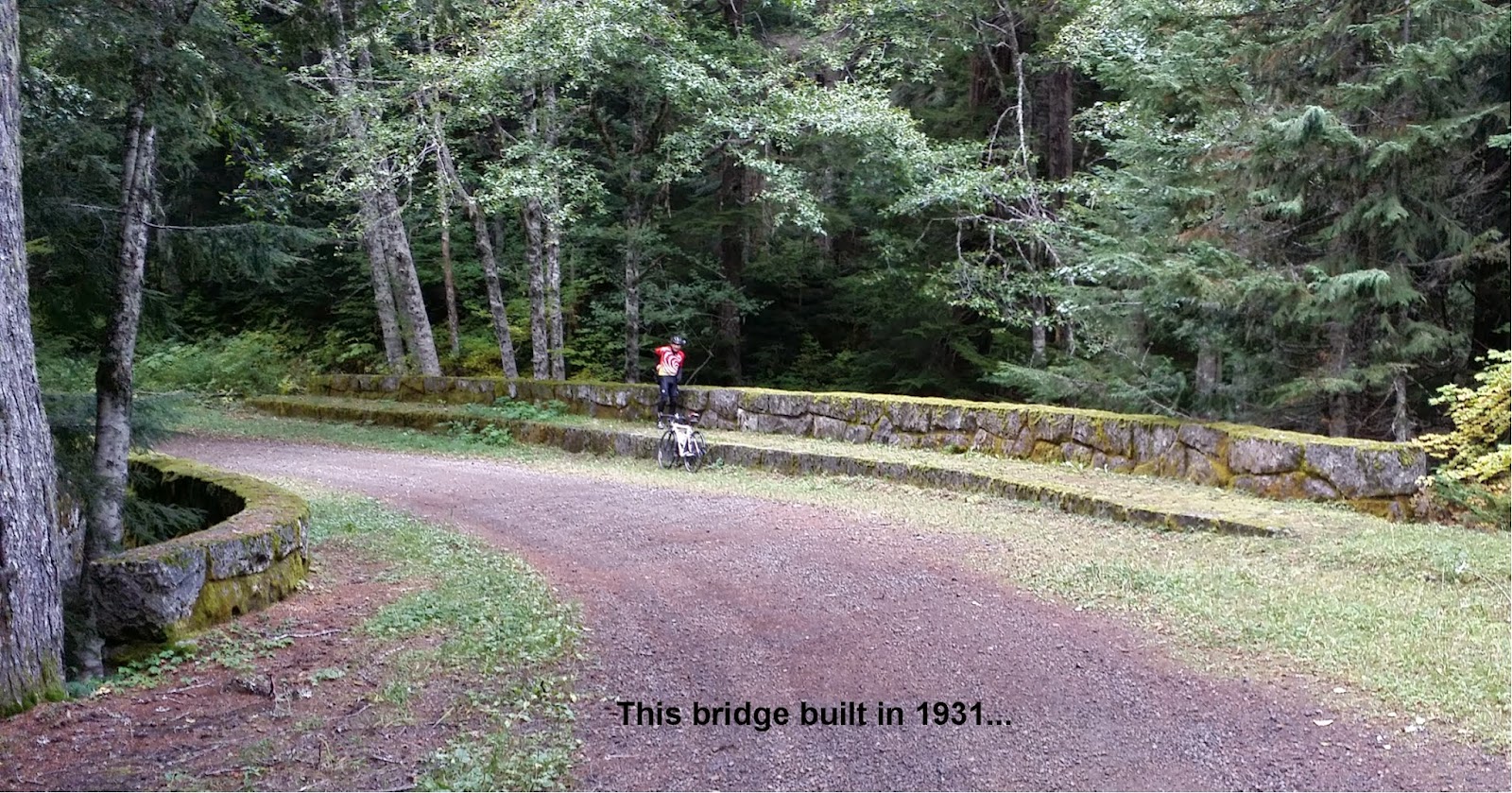
a couple of miles, we crossed a moss covered stone bridge (The South Puyallup
River Bridge) that was built around 1931 as part of the original Westside
Road Project. The bridge was in remarkably
good shape and was very distinctive in its appearance (it’s in the National
Historic Registry).
After stopping and taking some photos, we were soon
climbing again. A brief rain shower made
us take refuge under some roadside trees.
The shower only lasted about two minutes; but, during the stop we
discovered some beautiful mushrooms.
Back on the road, we soon crossed the St. Andrews Creek Bridge
– another stone bridge similar to The South Puyallup River Bridge. This bridge was different in that it included
steps that allowed you to walk right down to the river below – very cool.
After exploring the St. Andrews Creek Bridge and taking
photos, we resumed climbing toward Klapatche Point which was the
end of the road and the highest point on our ride at 4160 feet. The climb went smoothly, and we were soon
enjoying the views from the end of the road.
Retracing our path back to the cars was fun (mostly
downhill) and uneventful.
I purposely
did not send out an email to everyone about this ride; because it had been 15
years or so since I had last been on this road, and I was not certain what
condition it was in. I didn’t want to
drag 6 – 8 guys up here and have the ride be a disappointment. Now, having scouted the road, I think that
any of us who have a mountain bike or cyclocross bike or even a road bike with
30-35 mm tires would enjoy doing this ride.
Plan on us trying
to make this a group ride next year.
MFG Cyclocross brought the show to Lakewood last weekend. Those
guys have flair and it shows in the the naming of the event. Although my
race schedule doesn't usually include MFG events I figured if they
hosted an event in my backyard I needed to do my part and participate.
My last event cemented in my brain how important pre-race preparation
can be. For the Super Prestige I stuck with some proven rituals. Plenty
of water for the 24 hours before the event. Dinner before the race to
include pasta. And get to bed on time.
My race morning schedule was leisurely. I arrived at the venue in
plenty of time to handle paperwork and get kitted up. For the first time
I chose to invite my Garmin Edge 200 GPS cyclocomputer to go racing. To
prevent distraction I carried it in a pocket.
Because I know the trails
at Fort Steilacoom Park well I believed that my preride focus would be
on the turns laid out in the grass field and to see the transitions on
to and off of the straights.
Did I mention the straight away? Most of Angle Lane was used as the
finish straight. It was just over a quarter mile long and paved. A
sweeping corner led onto this straight away and a near perfect
decreasing radius corner exited the racers back onto the grass. Drafting
would become a factor on this long straight as well as a few other key
points on the course where the course was smooth and/or lined up with
the slight North wind.
A fast and straightish course does not favor my skillset. But my
preride revealed that the width and layout of many of the corners in the
grass sections did play to my strengths. There was just a single climb
on the course. It took riders up a moderate ascent to the near high
point in the park from where they executed a sharp righty and raced
right back down to the flats. The remainder of the course was basically
flat.
Between course preride and starting my warmup I chatted with another
racer named Rob. I was curious about his trainer based warmup ritual. He
gave me the Cliff Note's version and we decided to finish the
conversation after the race. My warmup ritual was almost comical.
There were enough bikes, cars, and kids at the Park to preclude
comfortably riding up and down the paved road. So I found Soccer field
'A', used the goals as turning marks, and rode near endless ovals around
them. The soft grass and ground provided resistance and I circled for
20 plus minutes while my body warmed up.
MFG's perfect decreasing radius first corner
The first two rows of the near 50 starters were awarded by callup.
Then riders were called up by random to fill the ranks. Luck fell my way
and I ended up on the third row.
My pre race strategy was determined nearly a week before the event.
Before I saw my start position. Before I saw the size or depth of the
field. My strategy was determined by the speed of the course. I needed
to suck wheels. On many courses I earn a little rest by carrying speed
through the corners. On this course I would only earn rest by keeping my
nose out of the wind. I also wanted to practice my pace setting. My
last blog post spoke of listening to my body and it was my intention to
keep that promise.
I lined up behind a rider who looked like he had his bike in the
correct gear. The rider too his left was in too tall a gear. The rider
too his right was on a single speed. This guaranteed an opening. Either
the guy on the left wouldn't accelerate or the guy on the right would
spin out before the first corner. Either way I'd advance a row before
the first corner.
It is my hope that this blog reaches the ear of the individual that
laid out the MFG Super Prestige course. That first corner was a work of
art. It safely funnelled 40+ racing cyclists into double file by the
second corner. By the third corner I was in about 10th and happy. The
course gets to the climb a third of the way into the lap. My climbing
speed was good but others wanted to climb faster. I needed to honor my
own pace. Two or three powered by.
As we executed the righty and started the first half of the descent they rested. Dwaine didn't rest. Not yet.
Time trial strategy dictates an even effort even after cresting a hill. Click, Click, Click as I accelerated down the hill.
Gravel Descent
From previous races the course was more worn on the far left side of
this gravel road to avoid the loose gravel in the center. Circuit
knowledge reminded me that the far right side was also firmly packed. As
my acceleration was not matched by the riders in front of me I was
forced to make the choice of slowing to their speed OR floating it
through the gravel to pick up the packed right side. It was a simple
choice and I stayed on the pedals as I realized the potential for gain.
On this first half of the descent I passed about four riders before the
descent turned left. Buoyed by my success I attacked on the brakes at
the bottom of the descent to gain one more spot.
Positionally, this was the high point of my race. I was solidly into
the top ten. For the remainder of the lap I just held the wheel in front
of me. If a rider behind needed to power by I let him go. If a rider
ahead chose a poor line I chose a better one. I found and held a wheel
down the front straight where it mattered most.
On the second lap there was a surge of speed on the second half of
the climb. I did not respond and watched the wheel open a gap. And then a
few riders went by. These rider had the strength to climb fast. I held
myself to a pace that I could sustain for five laps. On the plus side I
picked a few off on the second descent. But I knew they were faster and I
gave them plenty of room to get by on the next flat section.
Cyclocross colors
I wasn't the only rider unable or unwilling to keep pace with the
lead group. Initially four of us formed the second group. Early on I
heard 'we can bridge' but there was no response from anyone. I'm
guessing we all knew the score. Our group of four stayed together going
onto the front straight and a strong rider wearing Cucina Fresca colors
towed me down the straight with the other two hanging on.
Over the course of the next three laps our group mostly rode
together. And we each showed our strengths and weaknesses. I soft
pedaled into the grassy corners. They outclimbed me every time. Then I'd
close the gap on the descent. The other riders accelerated out of some
corners harder than me but I could usually make up the difference going
into the next turn. And we all knew the value of staying close as we
entered the straightaway.
I felt like one part of my prerace strategy was written in ink. Keep
my nose out of the wind. But on lap three, when our group had slimmed
down to three, I had to re-evaluate. Two riders, me included, had not
yet pulled. I'd rather get my work done early so I took the best pull I
could muster.
It's tough to know if the other riders were happy with my pace. But
it felt good to lead a group across the line and into the first corner.
This was my first shot at this decreasing radius. I stayed _way_ outside
skimming the outside fence and then bent it in as late as I could get
away with carrying much more speed than previous laps. The rest of my
group did not match my speed and I gained a short lived gap.
At the end of lap four the third rider in our group did not take his
pull. Cucina Fresca stepped up and did the work. I was tight on his
wheel and soft pedaled most of the straight.
By this point in the race I was mentally working the finish out
backwards. Our finish order would be decided by drafting on the
straight. The three short sections leading to the straight were
draftable but hard to pass. The barriers were just before the the three
short sections. And I was fastest through the four grassy corners
leading into the barriers.
On laps three and four I lead our group into the barriers where I was
slow and usually lost a position. But I worked hard to stick to the
wheel that came by. On the final lap it was the same and the Cucina
Fresca colors came by with authority. He gave extra effort on the first
of the three short sections. I held his wheel and the third in our group
held mine.
The author picks his own lines. Photo courtesy
http://triplesports.smugmug.com.
For right or wrong I conceded to myself that I couldn't beat both of
them. I'd work with Cucina Fresca. I was following close and I yelled up
that I would lead him out. Instead of waiting for the straight,
however, I wanted to get a gap on the wheel behind me early so I
sprinted past through the corner that led onto the long straight. Cucina
Fresca got on my wheel momentarily but then blew right on by. I surged
into his wind shadow, checked over my should to confirm our gap, and
then rode protected across the line.
Helmet hair courtesy Giro
The results were not exciting. We finished 9th and 10th in a field of
44 finishers. We were 80 seconds behind the winner. We did not meet the
podium girls. But I think we raced smart. I stuck to my goal of riding
my own pace. He did a mountain of the work and earned my respect when it
came time to pick sides.
The man inside the Cucina Fresca kit is Brian Palen. We had a chance
to chat after the race. I commented on his strength and he commented on
my cornering. We also realized we had raced against each other last year
at McCullogh park where we finished second and third in our Category 4
race.
Here is the summary from Strava:
My lap times were all within ten seconds of each other.
My two fastest laps, separated by only one second, were the first and last.
These metrics don't indicate that my pace was perfect. But they do indicate consistency. Which is a good start.
Although my finish position number wasn't particularly small I'm
quite pleased with my race. I mostly stuck with my plan. For the first
time in Category 3 I felt like I raced the race instead of it racing me.
I think I learned a little more about the nuances that are taking place
at this level of racing. And the fast course was a lot of fun.